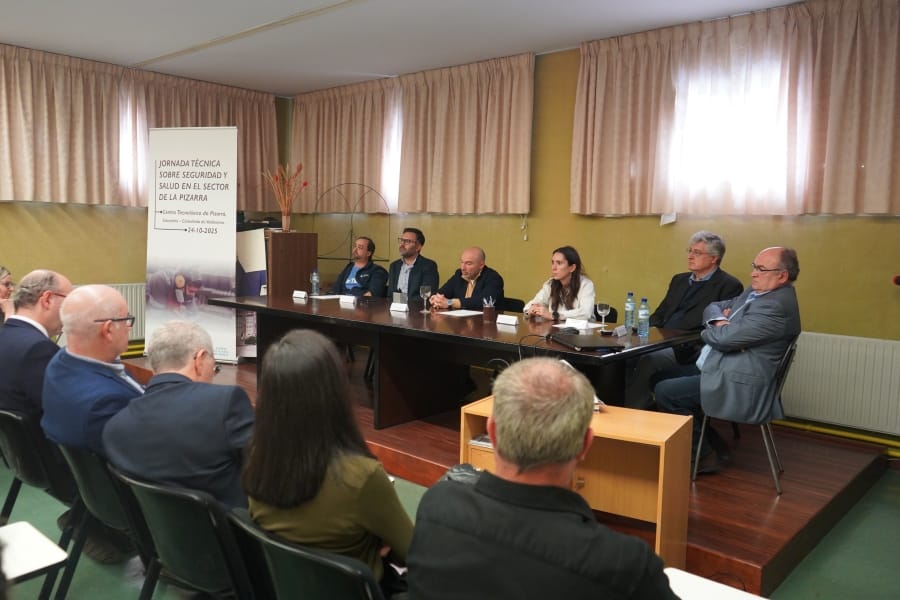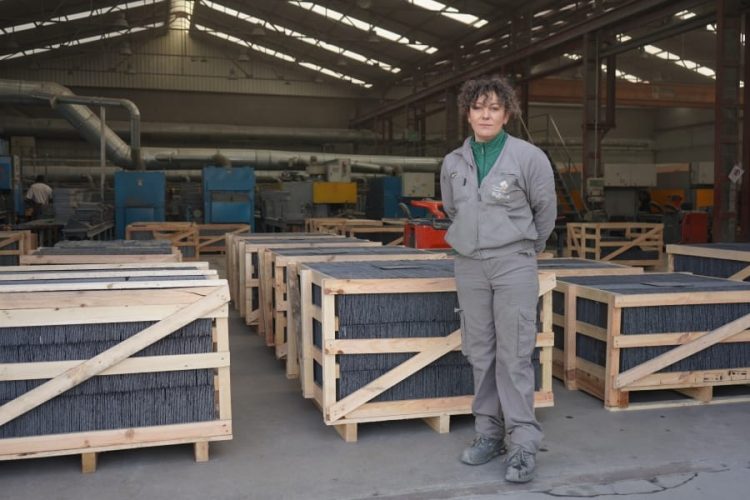

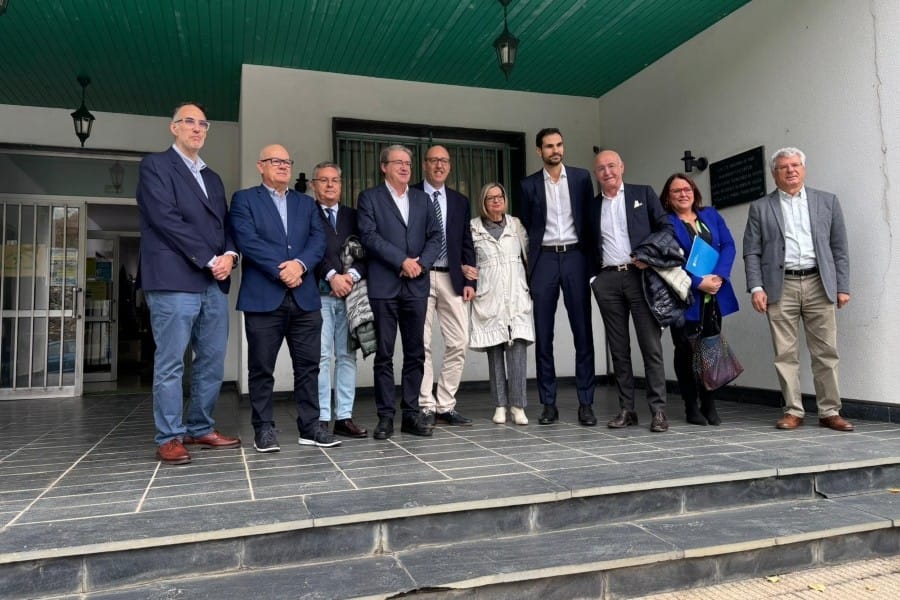
The Galicia Slate Cluster brought together more than 50 professionals from the slate sector for a Technical Conference on prevention and occupational health.
The Director General for Energy Planning and Mines, Pablo Fernández, reaffirmed the Xunta’s commitment to the slate industry, which in recent years has granted “more than 80 subsidies amounting to over 4.2 million euros to combat silica dust.”
The Galicia Slate Cluster held today’s Technical Conference on safety and health in the slate sector. More than 50 people gathered at the headquarters of the Slate Technology Centre in Sobradelo de Valdeorras to attend presentations given by experts in occupational risk prevention and industrial hygiene.
The Cluster’s president, Eliseo López, highlighted in his speech “the absolute commitment of the Cluster’s companies to safety and health, as demonstrated by the more than 8 million euros invested in these areas over the last four years.” He also thanked “the support of the Xunta de Galicia for providing more than 4 million euros in aid” for the development of projects in this field.
López also referred to the importance of holding this conference with contributions from experts in occupational safety and health—topics “that we believe deserve reflection” and for which “the companies in our sector work continuously, with investment increasing every year.”
Along the same lines, the Director General for Energy Planning and Mines, Pablo Fernández Vila, recalled that “it is very important to highlight that we have already granted more than 80 subsidies totalling over 4.2 million euros to combat silica dust.” He also mentioned “the progress made in recent years” and the importance of “organising conferences like today’s, which address these issues from a technical and health perspective.”
For her part, the mayor of Sobradelo, María Carmen González Quintela, asked during her closing remarks “that institutions continue investing in health and safety,” because, she explained, “we are here to solve the problems faced by slate workers, which have been discussed today.” She referred to dialogue “to address serious issues without creating social alarm” and to the importance of this type of activity, of which, as mayor of Carballeda, “she feels very proud,” she said.
The experts
Occupational Risk Prevention specialist Marcos Fernández, with more than 20 years of experience in the sector, explained the most recent regulations related to exposure to silica dust generated in the slate industry. “In 2020 there was a fundamental change in the sector: crystalline silica was classified as a carcinogenic agent.” The new regulation, he explained, “required a series of changes at all levels, and companies had to adapt.”
Next, engineers Daniel León and José Luis Folla spoke about the improvements already implemented in companies to reduce exposure to silica dust in the sector’s industries. After reviewing the improvements made at each stage, they concluded that despite “having to implement new measures in record time due to the imposed regulation,” there is still “a lot to test; the key is finding a balance between cost, benefit, and feasibility.”
Meanwhile, mining engineer and Industrial Hygiene expert Javier Madera addressed prevention of silica dust exposure within the framework of adapting to one of the most demanding pieces of legislation in Europe, with one of the strictest interpretations as well. He referred to the sector’s immediate future, which will apply, he said, “cutting‑edge solutions” to an issue in which “we are operating at a very high level” because “we have stepped on the accelerator” to achieve compliance.
Alberto Pérez, Professor of Physics at the University of Santiago de Compostela, spoke about a numerical modelling project carried out in two factories in the sector, addressing issues related to reducing the risk of exposure to respirable crystalline silica dust through computational fluid dynamics simulation. “We can work on prediction for prevention—that is, we can study how the new technology acquired by a company will function, which has a direct impact on workers’ health,” he explained.
In the final presentation, pulmonology specialist Dr. Laura Sierra discussed Occupational Risk Prevention in slate‑sector companies, breaking down each aspect of exposure to crystalline silica dust and its effects on the body. She advocated for “rigorous diagnosis” that “does not create confusion or alarm” regarding a disease that is “completely preventable” thanks to “preventive measures that help protect both the worker and the company.”
The technical conference concluded with a debate featuring the expert speakers, during which attendees raised practical questions they face in their daily work.